Midtopia

Midtopia

Friday, May 05, 2006

Judge calls wiretapping argument "gobbledygook"

An appeals court panel has sharply criticized the Bush administration's new rules making it easier to eavesdrop on Internet phone calls.

The skepticism expressed so openly toward the government's case during a hearing in U.S. Circuit Court for the District of Columbia emboldened a broad group of civil liberties and education groups who argued that the U.S. improperly applied telephone-era rules to a new generation of Internet services.

"Your argument makes no sense," U.S. Circuit Judge Harry T. Edwards told the lawyer for the Federal Communications Commission, Jacob Lewis. "When you go back to the office, have a big chuckle. I'm not missing this. This is ridiculous."

At another point in the hearing, Judge Edwards told the FCC's lawyer his arguments were "gobbledygook" and "nonsense." The court's decision was expected within several months.

Yowch.

The question at hand is whether Internet Service Providers are "information services", which are explicitly exempted from a 1994 law requiring that telephone service providers ensure their equipment can accomodate police wiretaps. That's what allows monitoring of e-mail conversations and instant messaging, for example.

On the other hand, the judge seemed to agree that the law covers "voice over Internet protocol", or VOIP, which uses Internet connections but functions just like a traditional phone.

This is not a big thing, especially since Congress could easily revise the law to more precisely spell out what they wish to allow. But it's good to see the judicial system keeping an eye out for civil liberties.

, , , , , ,

Porter Goss resigns

CIA director Porter Goss has resigned.

No reason was given. Goss has been mentioned as being somehow involved in Hookergate with former Rep. Randy Cunningham, but that connection looks tenuous. So unless there's more there than has come out publicly, let's look for less prurient reasons for the resignation. Like, say, his ongoing alienation of much of the senior staff at CIA, which have been resigning in droves. Or his reduced stature thanks to the ascension of John Negroponte as Director of National Intelligence. That raises other questions: Did Negroponte push him out?

More as it develops.

Update: The Washington Post's take.

Update 2: Another good question is what this means for the CIA's intelligence-gathering efforts. It's not a good sign that there remains so much turmoil at the agency 5 years after 9/11; It's still caught up in internal problems when we really want it to be focusing its efforts outward. Reform takes time, and will be distracting. The question is, were Goss' reforms the right ones? If so, will they be carried forward by his successor? Or will his tenure turn out to have been a year of spinning wheels that cost us momentum as well as a number of senior operatives?

, , ,

"Beyond reason"

The planned 9/11 memorial at Ground Zero in New York City is expected to cost -- are you ready? -- nearly $1 billion.

I'm not making this up.

Rebuilding officials concede that the new price tag is breathtaking — "beyond reason" in the words of one member of the World Trade Center Memorial Foundation board — and it is sure to set off another battle over development at the 16-acre site, with calls to cut costs, scale back the design or even start over.

This is just the memorial, not the commercial development going up at the site. And that's not counting an $80 million visitors' center being built by the state.

The new estimate, $972 million, would make this the most expensive memorial ever built in the United States.... It is likely to draw unfavorable comparisons to the $182 million National World War II Memorial in Washington, which opened in 2004; the $29 million Oklahoma City National Memorial, which opened in 2000; or the $7 million Vietnam Veterans Memorial in Washington, which opened in 1982.

Much of the problem is that the memorial would be underground, necessitating lots of expensive steel, concrete and labor. But that's hardly an excuse. Some of these estimates are dramatically higher than they were just a few months ago.

The report estimates the cost of just the memorial and its related museum at $672 million, up 36 percent from $494 million only four months ago. In addition, the latest projections include $71.5 million for an underground cooling plant, up from $41.5 million four months ago.

How does a cooling plant's cost go up 72 percent in just four months, except through really bad planning?

If the memorial foundation were able to raise that kind of money privately, then no problem. I'd still think it reflected seriously misplaced priorities, but it's private money. However, in perhaps a sign of good sense among the American public, the foundation has collected just $130 million so far.

New York's mayor and the governors of both New York and New Jersey have said the memorial shouldn't cost more than $500 million. That's still a bit mind-boggling, but as an upper limit it seems quite reasonable.

We need a memorial, and it should be tasteful, impressive and thought-provoking, as befits such a history-changing event. But turning its construction into an enormously expensive boondoggle would not do justice to the memories of the victims. Set a reasonable price tag, and then design the best memorial that fits the budget.

, , , , ,

Catch a criminal, catch some flak

In the "no good deed goes unpunished" category, the bartender that turned in escaped rapist Michael Benson has been suspended from her job.

Some people have even called her "a snitch," said Nina, who asked that her last name not be published for safety reasons.... Nina said that on Wednesday she was told not to come back to her job of nearly 14 years at Gates Bar-B-Q for a while.

"I don't know why. They told me if I need anything to call them," she said.

Excuse me? "Snitch?" For turning in a convicted rapist? Yeep.

The suspension is more murky. The "call us if you need anything" aspect suggests the suspension is merely for safety reasons, or to make the publicity go away more quickly, rather than some underlying disapproval of her actions. But what a hamhanded way to do it. I hope the suspension is with pay, including what her tips would have been.

, , ,

Bribery investigation closes in on La. Democrat

Following on the heels of the Mollohan case, here's another demonstration that Republicans don't have a corner on the corruption market:

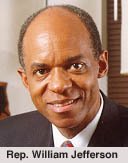
A while back, Brent Pfeffer, an aide to Rep. William Jefferson, D-La., pleaded guilty to demanding bribes and implicated his boss.

A couple of days ago, a contractor pleaded guilty to paying Jefferson more than $400,000.

Vernon Jackson, 53, chief executive of the Louisville, Ky.-based telecommunications firm iGate Inc., admitted to bribery of a public official and conspiracy to bribe a public official during a plea hearing in US District Court.

Court records make clear that the congressman whom Jackson admits bribing is Jefferson, who represents New Orleans in the House. ... Prosecutor Mark Lytle said Jackson paid $367,500 in checks and wire transfers over a four-year period to a company controlled by the congressman's wife in exchange for help promoting iGate technology in Africa. Jackson also gave the company a 24 percent stake in iGate and paid for $80,000 in travel expenses on the congressman's trips to Africa to promote iGate, which uses technology to transmit data over traditional telephone lines.

Jefferson denies wrongdoing. But prosecutors say he is the target of the investigation. And two solid convictions of other players, both of whom implicate Jefferson, spell bad news for the Congressman.

, , , , ,

Thursday, May 04, 2006

Making policy on the fly

Didn't get to this yesterday:

One might wonder why Senate Republicans haven't yet formally killed their gas tax proposal, given the near-unanimous condemnation it's receiving.

Besieged with complaints about political pandering, GOP lawmakers now say the rebate idea is a non-starter. As Sen. Trent Lott (R-Miss.) explained yesterday, "When my own daughter harasses me, you know you're in trouble."

So declare it dead already, and let's move on.

The reason they haven't might be that lawmakers haven't come up with something equally pandering to replace it. But the real problem, which is the linked article's main point, is that legislators were making this stuff up on the fly.

The response so far has been profiles in panic. Some conservatives dropped their philosophical opposition to tax hikes and business regulations and began complaining loudly about oil companies and the auto industry. ... A few days earlier, Bush backed diverting crude oil from the Strategic Petroleum Reserve, an idea he dismissed less than two years earlier as a political stunt. ... Republican lawmakers likewise have responded with a mishmash of solutions -- some barely vetted, others with little chance of becoming law.

The Democrats get points for at least being consistent, even though their ideas are no more effective or on point than the GOP's.

Memo to all of our elected leaders: Calm down.

The thing about high gas prices is that it is not a crisis. It is (hopefully) a new chronic condition. So hasty, temporary measures to deal with it are ill-conceived at best.

Forget the attempt at short-term, short-sighted fixes. You can't do much anyway. Instead, take a deep breath and do the things that need to be done to assure our long-term energy security -- which means taking steps to reduce our oil dependence.

Do a good job at that -- show that you are sober, smart and willing to take risks to do what must be done -- and maybe your prospects in November will improve.

, , , , ,

San Diego ordered to take down giant cross

A cross that has stood atop a city-owned mountaintop in San Diego for decades may have to come down after a 17-year legal battle.

A federal judge moved to end a 17-year legal saga yesterday by ordering the city of San Diego to remove the Mount Soledad cross from city property within 90 days or be fined $5,000 a day.

“It is now time, and perhaps long overdue, for this Court to enforce its initial permanent injunction forbidding the presence of the Mount Soledad Cross on City property,” U.S. District Judge Gordon Thompson Jr. said.

The 29-foot cross was dedicated in 1954 at the site of a Korean War memorial. A resident sued in 1989 to have it removed. Several attempts to transfer the land under the cross to private groups have been disallowed. So now the cross will likely be moved to nearby private land.

The mayor of San Diego has indicated a willingness to continue fighting the case, but the city is strapped for cash and can ill-afford the fines.

This has become a cause celebre for conservative groups, in part because the original plaintiff was an atheist, and he received assistance from the ACLU. But the legal reasoning seems very clear:

In his ruling, Thompson said he has spent years hearing arguments over the cross, as have other courts.

“Consistently, every court that has addressed the issue has ruled that the presence of the Latin cross on Mount Soledad, land which is owned by the city of San Diego . . . violates Article I Section 4 of the California Constitution,” he said in his order.

I'm not the sort to get all offended by a giant cross overlooking a city -- I actually think the big statue of Jesus that overlooks Rio de Janeiro is pretty cool. But this is about the law, not my personal lack of offense. And the law makes sense. It is wrong for our government to have a cross represent all Korean War vets, as if they were all Christian or even believers. And it is wrong to use city property to promote one religion above all others.

One could argue that the cross has historic significance. After all, we wouldn't move the cross if it was hundreds of years old. Southwestern states operate old Spanish missions as historic sites, for example, and the religious symbols are part of the presentation.

But presenting religion in a historic context is clearly distinct from promoting it. More to the point, the San Diego cross has scant historic value, being less than 60 years old. That is not enough to overcome the importance of the government being seen as neutral on belief -- and nonbelief.

The solution is simple, and has already been planned: move the cross to nearby public land. The cross is preserved and it is still highly visible. But you will no longer have one religion using the levers of governmental power to promote itself.

, , , ,

A general's inside take on Iraq

Fred Kaplan over at Slate reports on a memo that retired Army Gen. Barry McCaffrey wrote about the situation and prognosis in Iraq. McCaffrey supports the war and now teaches at West Point.

The assessment won't surprise anyone who has been paying attention. Our troops are doing a professional job, and the Iraqi army is coming along. But the security situation is worsening, the Iraqi police and army units are underequipped, underfunded and unable to fight on their own and reconstruction aid is dwindling to nothing.

He estimates it will take 10 years and about $100 billion in economic aid alone to achieve what we set out to achieve in Iraq. Add another $700 billion or so to that total for military operations, if you look at our current rate of spending.

It's an excellent and balanced piece, and points up what I've said for a long time: had the benefits, perils and costs of invading Iraq been fairly and openly debated, the American public would never have signed on. Whatever you may think about the morality of invading -- and I'm generally okay with the idea of taking out bad guys -- I'm pretty sure we could have found better ways to spend $2 trillion.

Go give it a look.

, , , ,

Wednesday, May 03, 2006

Specter to hold hearings on Bush conduct

Sen. Arlen Specter said Wednesday that he would hold hearings on the Boston Globe report that Bush has simply ignored 750 laws he disagrees with.

The chairman of the Senate Judiciary Committee, accusing the White House of a "very blatant encroachment" on congressional authority, said yesterday he will hold an oversight hearing into President Bush's assertion that he has the power to bypass more than 750 laws enacted over the past five years.

"There is some need for some oversight by Congress to assert its authority here," Arlen Specter, Republican of Pennsylvania, said in an interview. "What's the point of having a statute if . . . the president can cherry-pick what he likes and what he doesn't like?"

Specter said he plans to hold the hearing in June. He said he intends to call administration officials to explain and defend the president's claims of authority, as well to invite constitutional scholars to testify on whether Bush has overstepped the boundaries of his power.

Good. That's a first step. Bush has dared Congress to rein him in; if Congress has any concern at all for its relevance as an institution, they should call that dare.

Specter makes the same point:

Specter said that challenging Bush's contention that he can ignore laws written by Congress should be a matter of institutional pride for lawmakers. He also connected Bush's defiance of laws to several Supreme Court decisions in which the justices ruled that Congress had not done enough research to justify a law.

"We're undergoing a tsunami here with the flood coming from the executive branch on one side and the judicial branch on the other," Specter said. "There may as well soon not be a Congress. . . . And I think that most members don't understand what's happening."

The founders envisioned three branches of government, each jealously guarding their prerogatives, as a way to prevent any one organization from dominating the country. The party system has distorted that; Congressional Republicans now have first loyalty to the president as the leader of the party, as Congressional Dems did under Clinton. Bush has played that for everything it's worth; perhaps now Congress will awaken and push back, once again taking up the Constitutional responsibility that the founders envisioned for it.

, , , ,

"20th hijacker" gets life

Zacarias Moussaoui was sentenced to life in prison today, the jury still split after seven days of deliberation.

Edward Adams, a court spokesman, announced the verdict outside the courthouse and said the 12 jurors "were not unanimous" in favor of a death sentence for Moussaoui, meaning that he automatically gets a life sentence without possibility of parole. He said the verdict does not indicate how many jurors voted for a death sentence and how many opted to keep the defendant in prison.

Works for me. The guy is a nutter, IMO. Not in the legally defensible sense of not knowing right from wrong, but certainly in the colloquial sense of not being rational. He was clearly guilty, so a death sentence would have been defensible. But life in prison serves justice. And as I'll argue below, it has other benefits, too.

"America, you lost. I won!" Moussaoui yelled as he was escorted from the U.S. District courtroom in Alexandria after the verdict was read. He clapped his hands as he left.

He's mistaken. We won. Anyone can execute a widely hated criminal. Only a free and democratic country gives that criminal a fair trial and then spares his life. The fact that he cannot understand that speaks volumes about the gulf between his worldview and ours.

But speaking of nutters:
"A travesty of justice"
"I hope this ends our little experiment in judicial trials"
"Imbecilic asswipes."

And then there's the illogical:
"Moussaoui just made a chump out of the United States"

These folks don't understand the difference between strength and savagery. All execution takes is fear or vengeance. But it took confidence and strength to let him live. Today we made clear that we do not fear him or his ilk, which is a powerful message to send to a watching world.

, , ,

Hamas blames U.S. for lack of funds

The Palestinian prime minister is blaming the U.S. for its money troubles, saying we're blocking various attempts to get money into Palestine to pay employees.

Haniyeh appealed to Arab leaders to face up to the Americans "to stop the siege imposed on the Palestinian people and to stop the political blackmail against the government." He also called on Palestinian bankers to "show the necessary patriotism."

Uh, no. The real problem here is that Hamas refuses to recognize Israel's right to exist, and attempted to justify suicide bomb attacks against civilians as recently as last month. They're free to do that, but such positions carry consequences. And those consequences can be severe when you're almost entirely dependent on Western aid for your economy. But it's silly to think you can bite the hand that feeds you and expect the feeding to continue.

Hamas has two choices: assume a more responsible stance on Israel, or get used to being strapped for cash. Palestinian voters have their own choices: to pressure Hamas to change, to support Hamas and accept the attendant economic problems, or vote them out.

My sympathy is with the voters, because the main alternative -- Fatah -- has failed them repeatedly over the years and is notoriously corrupt. We should show good faith by pressuring Fatah to reform, as hard as we've pressed Hamas to recognize Israel. That way the Palestinians would have at least one reasonable choice instead of two bad ones.

, , , ,

Lip service

Given my previous post about Bush ignoring laws, this would seem to qualify as unintentional comedy.

My question for Bush would be: how do you envision the "balance of powers" operating when you arrogate for yourself the right to decide whether a law is constitutional or not and when you shroud your actions in secrecy -- even, at times, from Congress?

, ,

Tuesday, May 02, 2006

New taxes dead, pander still on life support

Senate Republicans can act quickly when necessary -- such as when their business allies object to proposed new taxes.

Senate Republicans on Monday hurriedly abandoned a broad tax proposal opposed by the oil industry and business leaders, another sign of their struggle to come up with an acceptable political and legislative answer to high gasoline prices.

Senator Bill Frist of Tennessee, the majority leader, said he had decided to jettison the provision, which would have generated billions of dollars by changing the way businesses treat inventories for tax purposes. Instead, he said the Senate Finance Committee would hold hearings on the plan "later this year, so the pluses and minuses of the provision can become well known."

I actually think the proposal should never have been made in the first place: oil company profits are the least of my worries. But it shows once again how clueless Frist is.

Meanwhile, the $100 rebate plan has not yet had its plug pulled. But sweet merciful death can't be far away, especially because income from the tax provision is supposed to pay for the rebate.

The centerpiece of the leadership proposal, a $100 rebate check to compensate taxpayers for higher gasoline prices, continued to receive a rough reception. Members of the public have telephoned and written to ridicule the idea, and even Republican lawmakers are finding fault.

"Political anxiety in an election year is to blame for a lot of the bad bills Congress passes," said Representative Jeff Flake, Republican of Arizona, who on Monday called the rebate a "knee-jerk populist idea" that voters would see through.

The rest of the bill has some other elements:
The measure includes new protections against price gouging, incentives to expand domestic oil refinery capacity, support for new energy initiatives and tax incentives for buying hybrid vehicles.

Ditch the price-gouging protections, because I have yet to see evidence of it being a widespread problem and anyway I want gas to be more expensive. Expanding refining capacity is fine, because refining is the main bottleneck in our energy supply line. But tax incentives are less important than overcoming political and environmental opposition to their construction.

Support for new energy initiatives is fine as long as it's different sources of energy, not just drilling in ANWR and other such measures that will have no short-term effect and in the long-term will just provide an excuse to continue our oil dependence -- all while incurring lasting environmental damage.

Tax incentives for hybrids is nice, but misses the point. Target the tax incentive at fuel efficiency, not one particular type of motor. I don't care if the car is a hybrid design or not; all I care about is that it gets 50 miles to the gallon.

I'll also note, yet again, that all of these tax incentives and funding options and so on and so forth would be totally unnecessary if we do one thing: keep the price of gas high. Do that, and people will pursue the other options on their own, out of naked self-interest.

, , , , ,

Police intelligence units stage comeback

In conjunction with yesterday's report that Bush is simply ignoring laws he doesn't like, this all starts to sound like variations on a theme. From U.S. News & World Report:

Since 9/11, the U.S. Departments of Justice and Homeland Security have poured over a half-billion dollars into building up local and state police intelligence operations. The funding has helped create more than 100 police intelligence units reaching into nearly every state.

To qualify for federal homeland security grants, states were told to assemble lists of "potential threat elements"--individuals or groups suspected of possible terrorist activity. In response, state authorities have come up with thousands of loosely defined targets, ranging from genuine terrorists to biker gangs and environmentalists.

Guidelines for protecting privacy and civil liberties have lagged far behind the federal money. After four years of doling out homeland security grants to police departments, federal officials released guidelines for the conduct of local intelligence operations only last year; the standards are voluntary and are being implemented slowly.

I'm okay with the police being on the lookout for terror suspects. But basic standards of evidence and conduct need to be followed, or any such system is guaranteed to be abused.

U.S. News has a sidebar on why pervasive police surveillance is troublesome.

Starting in the 1970s, lawsuits and grand jury investigations uncovered all kinds of abuse by these units: illegal spying, burglaries, beatings, unwarranted raids, the spreading of disinformation. Americans engaged in constitutionally protected free speech were routinely photographed, wiretapped, and harassed--all in the name of national security. In Memphis, the police department spied on the National Association for the Advancement of Colored People and gathered data on political activists' bank accounts, phone records, and close associates. In New Haven, Conn., police wiretapped over a thousand people. In Philadelphia, then police chief Frank Rizzo boasted of holding files on 18,000 people. The list of "subversives" grew to include the League of Woman Voters, civil rights groups, religious figures, and politicians running for office.

If you want even more history and examples of how police powers can be abused, I heartily recommend Geoffrey Stone's book "Perilous Times: Free Speech in Wartime." It traces the history of free speech law from the founding of the Republic.

The FBI did all sorts of heinous things under its COINTELPRO initiative, including arranging for antiwar activists to be fired, sabotaging the campaigns of antiwar candidates, mailing anonymous letters to their spouses suggesting the activists were having affairs, causing activists to be evicted, disabling their cars, intercepting their mail, planting derogatory information about them in the press.... the list goes on.

Then there's the blurry line between infiltration and agitation:

1. A state undercover agent served as co-chair of the Students for a Democratic Society chapter in Columbia, S.C.

2. Another became chairman of the SDS chapter at the University of Texas.

3. Agents infiltrating the SDS chapter at Northwestern led a sit-in in 1968 and then actively participated in a 1969 Weatherman action.

4. Other Chicago undercover operatives provided explosives to the Weathermen, encouraged them to shoot the police, and led an assault upon a uniformed police sergeant during a demonstration, which was widely publicized as "proving the violence" of the New Left.

Supporters of this resurgence in police activity say that the police have learned the lessons of history and will be more careful this time. I'm not reassured, especially given the examples in the U.S. News story.

In February 2006 near Washington, D.C., two Montgomery County, Md., homeland security agents walked into a suburban Bethesda library and forcefully warned patrons that viewing Internet pornography was illegal. (It is not.)... Similarly, in 2004, two plainclothes Contra Costa County sheriff's deputies monitored a protest by striking Safeway workers in nearby San Francisco, identifying themselves to union leaders as homeland security agents.

Union leaders and Web surfers. Well, I suppose they could cause trouble. But how about this one, from here in Minnesota?
In Minnesota, the state-run Multiple Jurisdiction Network Organization ran into controversy after linking together nearly 200 law enforcement agencies and over 8 million records. State Rep. Mary Liz Holberg, a Republican who oversees privacy issues, found much to be alarmed about when a local hacker contacted her after breaking into the system. The hacker had yanked out files on Holberg herself, showing she was classified as a "suspect" based on a neighbor's old complaint about where she parked her car.

Scary on two counts: the absurdness of the classification system and the insecurity of the data.

Or how about the lead example in the story:

[In Atlanta], two agents were assigned to follow around the county executive. Their job: to determine whether he was being tailed--not by al Qaeda but by a district attorney investigator looking into alleged misspending. A year later, one of its plainclothes agents was seen photographing a handful of vegan activists handing out antimeat leaflets in front of a HoneyBaked Ham store. Police arrested two of the vegans and demanded that they turn over notes, on which they'd written the license-plate number of an undercover car,

DAs and vegan protesters. Not good.

The fight against Al Qaeda is morphing into an intimidation campaign against the same old "troublemakers". We've been down this road before; it will be shameful if we go down it again.

, , ,

Monday, May 01, 2006

Bush: I AM the law!

The Boston Globe has a piece that you would swear was satire. Except it's not.

President Bush has quietly claimed the authority to disobey more than 750 laws enacted since he took office, asserting that he has the power to set aside any statute passed by Congress when it conflicts with his interpretation of the Constitution.

Among the laws Bush said he can ignore are military rules and regulations, affirmative-action provisions, requirements that Congress be told about immigration services problems, "whistle-blower" protections for nuclear regulatory officials, and safeguards against political interference in federally funded research.

Now, on one level Bush is correct: he's as free to ignore laws as the next guy. But there are consequences to doing so. The President is generally not at risk for criminal prosecution, but Congress is free to impeach him.

In addition, his general attitude has been shared by many presidents -- none of whom, for instance, have ever recognized the authority of the War Powers Act even as they complied with it.

What sets Bush apart is, as always, his method and the sheer scope of his reach. His method is to simply ignore the law and hope nobody notices. And the scope is of truly historic proportions.

Far more than any predecessor, Bush has been aggressive about declaring his right to ignore vast swaths of laws -- many of which he says infringe on power he believes the Constitution assigns to him alone as the head of the executive branch or the commander in chief of the military.

Many legal scholars say they believe that Bush's theory about his own powers goes too far and that he is seizing for himself some of the law-making role of Congress and the Constitution-interpreting role of the courts.

The Constitution requires the president to "faithfully execute" the laws. If he thinks they aren't Constitutional, there's a way to check that: take the case to the Supreme Court and get a ruling. Instead Bush imposes his own interpretation on the Constitution, which would appear to be unconstitutional and clearly unethical.

The story also gets into the effect of his "signing statements":

Bush is the first president in modern history who has never vetoed a bill, giving Congress no chance to override his judgments. Instead, he has signed every bill that reached his desk, often inviting the legislation's sponsors to signing ceremonies at which he lavishes praise upon their work.

Then, after the media and the lawmakers have left the White House, Bush quietly files "signing statements" -- official documents in which a president lays out his legal interpretation of a bill for the federal bureaucracy to follow when implementing the new law. The statements are recorded in the federal register.

In his signing statements, Bush has repeatedly asserted that the Constitution gives him the right to ignore numerous sections of the bills -- sometimes including provisions that were the subject of negotiations with Congress in order to get lawmakers to pass the bill. He has appended such statements to more than one of every 10 bills he has signed.

"He agrees to a compromise with members of Congress, and all of them are there for a public bill-signing ceremony, but then he takes back those compromises -- and more often than not, without the Congress or the press or the public knowing what has happened," said Christopher Kelley, a Miami University of Ohio political science professor who studies executive power.

Another seemingly clear-cut example:
The Constitution grants Congress the power to create armies, to declare war, to make rules for captured enemies, and ''to make rules for the government and regulation of the land and naval forces." But, citing his role as commander in chief, Bush says he can ignore any act of Congress that seeks to regulate the military.

Bush is wrong. As Commander in Chief, Bush is solely responsible for the conduct of the war; you do not want 480 Congressmen playing general. But he is merely the executor of the will of the people as expressed by Congress; the rules he operates under and even the strategic direction are ultimately Congress's responsibility. His relationship to Congress in this regard is a bit like the relationship that the Joint Chiefs have with the President: they conduct the operations, but they do so at the President's direction.

Bush is pulling what amounts to a dare: he does what he likes, and if Congress doesn't like it they can either drag him before the Supreme Court or cut off funding for his activities. Congress is reluctant to take so explosive a step in most circumnstances, and is even less likely to do so with Republican majorities in both houses. And so Bush is able to run roughshod over everyone.

There's a lot more to the story, with many more examples. I recommend reading it all.

What does it say about Bush's personality that he will sign a bill, then quietly add a statement saying he doesn't have to obey it? Are those the actions of an ethical, brave, stand-up, straight-talking leader? Not even close. To me they are more reminiscent of the little boy who breaks the rules and hopes he won't get caught.

What does it say about the balance of powers when Bush plainly states he will ignore any law he doesn't like, even laws he signed? It's a rather breathtaking act of political brinksmanship, daring Congress to impeach him or fold. Each individual dare might not be worth a Congressional challenge. But it sure seems worth it in the aggregate.

As long as there is a Republican Congress, any such challenge will be slow, halting and weak. It's yet one more reason to hope for a change of control in November: so that Congress can once again fulfill it's mandated role as a check and balance on the power of the executive branch.

, , ,

Gas prices start to pinch

The Star Tribune today had a big A1 centerpiece on how higher gas prices are affecting homeowners and commuters.

The main revelation to me is that some people spend $500 a month on gas alone, not to mention the hour or two spent in traffic each day. That doesn't count the cost of buying, maintaining and insuring a car or two.

Are they insane?

It also cites a couple of studies that try to measure the transportation cost of living in various parts of the Twin Cities. One is by the Center for Neighborhood Technology; the other is by the Brookings Institution.

A lot of people decided to buy in the far-flung exurbs because the houses were a lot cheaper there. But there's a reason they're cheap, and many homeowners are now figuring out why.

If gas prices remain high, home prices will rise in the central cities and decline further in the sticks. But they're not going to fall enough to totally offset the ongoing cost of commuting, year after year.

The long-term implications could be interesting.

For starters, the "sweet spot" -- where combined housing and commuting costs are the most affordable -- will move inward somewhat. If mass transit gets a renewed lease on life, it will move in even closer, as those "expensive" homes in the city turn out to be cheaper in the long run. Even far-flung development will be affected, as it follows bus and rail lines rather than highways. That's one reason communities along the proposed Northstar commuter line strongly support its creation.

Meanwhile, businesses may seek to reduce transportation costs by locating near a rail line in the exurbs. That will allow residents to stop commuting into the city and instead drive to a local workplace. The small-town downtown may flourish again, creating a ring of minicities around the large central ones.

High gas prices may, in the end, achieve what government could or would not: curbing sprawl and the inefficient use of resources that goes with it. Yet another example of how dealing with the true cost of gasoline helps society as a whole make more rational choices.

Separately, MPR's Midmorning show had an interview with Oregon Rep. Earl Blumenauer, who's in town to take part in the Great Conversations series at the University of Minnesota. Blumenauer helped develop the Portland, Ore., transit system and is something of an expert on urban management and growth. They discussed several things, but Blumenauer made two points that resonated with me:

Zoning laws need to change. As long as we require people to drive to the mall or strip mall to shop, car usage remains necessary. A better idea is to have local stores within neighborhoods for small needs, and transit-linked shopping destinations for more regional draws. Right now, though, that's almost impossible because many zoning laws -- most of them drawn up decades ago and altered little since then -- still require sharp separations between commercial and residential districts.

Commuters deserve options. Blumenauer noted that the Twin Cities are less densely populated than Portland and have far more miles of highway. Yet we have more traffic congestion. That should be a flashing red sign that more highways are not a solution.

He expressed surprise that the Twin Cities is so far behind the rest of the country in the adoption of light rail, when even once-adamant opponents such as Phoenix, Denver and Houston now have systems. He said the goal should not be to force people to use mass transit; it should be to give them options, so they can decide what to use. Over time it leads to fewer roads, less traffic and less sprawl.

We have high gas prices to thank for the re-emergence of this sort of conversation. And it's yet one more reason why we should not be trying to lower those prices.

, , , , , , , , ,

Ann Coulter watch

30 days ago, Ann Coulter was given 30 days to respond to allegations that she knowingly voted in the wrong precinct -- or knowingly listed an incorrect address on her registration form.

No word yet on what that response was, or if she met the deadline. As soon as anything comes to light, I'll post it here. Not because it's important, but because I can't help enjoying the sight of Ann Coulter on the defensive.

, ,

Senate Republicans get an earful

Some days I'm quite hopeful that the American people are paying attention.

The Senate Republican plan to mail $100 checks to voters to ease the burden of high gasoline prices is eliciting more scorn than gratitude from the very people it was intended to help.

Aides for several Republican senators reported a surge of calls and e-mail messages from constituents ridiculing the rebate as a paltry and transparent effort to pander to voters before the midterm elections in November.

"The conservatives think it is socialist bunk, and the liberals think it is conservative trickery," said Don Stewart, a spokesman for Senator John Cornyn, Republican of Texas, pointing out that the criticism was coming from across the ideological spectrum.

Angry constituents have asked, "Do you think we are prostitutes? Do you think you can buy us?" said another Republican senator's aide, who was granted anonymity to openly discuss the feedback because the senator had supported the plan.

Beautiful.

And guess which senator has the tinniest ear? Hint: he'd like to run for president in 2008.
Eric Ueland, chief of staff to Senator Bill Frist of Tennessee, the Republican leader, whose office played a main role in pulling the proposal together, said the rebate was an important short-term step in a broader array of measures that began with last year's energy bill. Constituents "believe government ought to step up to the plate rather than loll around in the dugout," Mr. Ueland wrote in an e-mail message on Sunday.

Uh, no. Congress should do things that actually address the long-term problem of oil dependency, not continue that dependency with election-year bribes. "Lolling around in the dugout" precisely describes the rebate plan, as well as the Democratic proposal to suspend the gas tax.

I'm glad that a lot of Americans appear to realize that. Frist is once again demonstrating why he will not be president in 2009.

, , , , ,

Did Bush let Zarqawi live for political reasons?

We start off Monday with a potentially explosive report: Confirmation from a CIA official of long-standing reports that George Bush held off on trying to nail al-Zarqawi back in 2002.

The revelation came on an Australian TV show called "Four Corners." The source? Former CIA man Michael Scheuer, who headed the CIA's Osama bin Laden effort for six years. He's been talking about the war on terror for a while now. His words:

Mr Scheuer claims that a July 2002 plan to destroy the camp lapsed because "it was more important not to give the Europeans the impression we were gunslingers".

"Mr Bush had Zarqawi in his sights almost every day for a year before the invasion of Iraq and he didn't shoot because they were wining and dining the French in an effort to get them to assist us in the invasion of Iraq," he told Four Corners.

"Almost every day we sent a package to the White House that had overhead imagery of the house he was staying in. It was a terrorist training camp . . . experimenting with ricin and anthrax . . . any collateral damage there would have been terrorists."

The "not wanting to cheese off the French" explanation seems quite weak, given Bush's general indifference to French opinion. But that could well be what the administration told the CIA.

A seemingly more plausible reason, and what makes this confirmation potentially important, is this:

During the lead-up to the invasion of Iraq, Zarqawi's presence in the north of the country was used by US officials to link Saddam Hussein to terrorism.

In other words, Zarqawi's continued presence was convenient in helping to build the case for war against Iraq. Never mind that the camp was in Kurdish-controlled territory and thus well outside the part of Iraq that Saddam controlled.

If Bush really held off nailing a known terrorist for political reasons, he has a lot of explaining to do. Maybe he didn't consider Zarqawi and his group important; but then he shouldn't have been citing the group as evidence of Saddam's support for terror.

For more viewpoints, the story is being heavily discussed on Kevin Drum's blog at the Washington Monthly.

, , , , ,

Friday, April 28, 2006

FBI probes 3,500 without warrants

In a report required as part of the renewal of the Patriot Act, the Justice Department said Friday that the FBI secretly sought information on 3,501 U.S. citizens and legal residents last year. The report covers some but not all National Security Letters, which let the government obtain records without a judge's approval or a subpoena.

3,500 is fewer people than had been feared, although the report doesn't count "requests for subscriber information", so the true number is substantially higher. But I continue to be mystified why we would grant our government permission to spy on whomever it wants whenever it wants. It's not just that it invites abuse and is inimical to liberty. If there's not enough substantiation to get a warrant or a subpoena -- which aren't very hard to get in the first place -- that's reasonably good evidence that the surveillance is unwarranted.

Further, if we know enough about a suspect to demand their records, then we know enough about them to investigate them through other, less violative means. This isn't like warrantless wiretaps, which in the Hollywood scenarios favored by supporters offer at least the possibility of preventing an imminent attack. As the Washington Post explained in November, NSLs are investigative tools, not emergency interventions.

A national security letter cannot be used to authorize eavesdropping or to read the contents of e-mail. But it does permit investigators to trace revealing paths through the private affairs of a modern digital citizen. The records it yields describe where a person makes and spends money, with whom he lives and lived before, how much he gambles, what he buys online, what he pawns and borrows, where he travels, how he invests, what he searches for and reads on the Web, and who telephones or e-mails him at home and at work.

(snip)

Since the Patriot Act, the FBI has dispersed the authority to sign national security letters to more than five dozen supervisors -- the special agents in charge of field offices, the deputies in New York, Los Angeles and Washington, and a few senior headquarters officials. FBI rules established after the Patriot Act allow the letters to be issued long before a case is judged substantial enough for a "full field investigation." Agents commonly use the letters now in "preliminary investigations" and in the "threat assessments" that precede a decision whether to launch an investigation.

In other words, agents use warrantless snooping to decide if they're going to launch a full-scale investigation. Warrantless searches have become a first and routine step, instead of a narrow and extreme exception to the law.

I am appalled.

, , , , ,