Midtopia

Midtopia

Wednesday, May 31, 2006

Democracy advances in the Midwest

I'm so proud!

Minneapolis voters likely will get a chance to consider instant-runoff voting in city elections, eliminating primaries and greatly leveling the playing field for independent candidates.

The idea could be a ballot question this November. But don't hold your breath after that: Because such a system means someone's ox is being gored, it will be awhile before such a system is implemented.

Even if voters approve the change, a new style of voting could be a long way off in Minneapolis because of the cost and potential legal challenges....

The earliest city election that could be affected by the change would be in 2009, but Benson said the council could push that back if the cost of acquiring the software to count the votes is prohibitive.

"I don't think anybody on the council is interested in spending $1 million to do this," he said.

To their credit, the Minneapolis DFL (that's Democrats to you out-of-staters) supports the idea. Republicans generally oppose it, for the vaguest reasons. When Roseville tried to adopt the system in 2004, State Senate Democrats approved it but the Republican-controlled House shot it down. House Speaker Steve Sviggum suggested it violates the "one person, one vote" system.

Maybe Sviggum really believes that. Or maybe he's concerned that IRV lessens the influence of parties and empowers voters to vote for the person they really want, rather than choosing the major party candidate that offends them the least.

There are legitimate practical concerns about IRV -- how to ensure the ballots aren't confusing, how to deal with races where, say, six candidates are competing for two open seats, and so on. But those are technical questions, and solvable; they do not justify slamming the door on IRV. As wielded by Sviggum and others, they are just a smoke screen.

If Minneapolis adopts the system, the next step would be to see it applied to county and state races. Minnesota governor races, in particular, have been three-way circuses in recent years; instant-runoff voting would have made those contests fairer and more accurate, with the winner truly reflecting the electorate's preferences.

, , , ,

Tuesday, May 30, 2006

Supreme Court whistleblower ruling

Today the Supreme Court made what is being called a significant ruling on protections for government whistleblowers.

In a victory for the Bush administration, justices said the 20 million public employees do not have free-speech protections for what they say as part of their jobs.

Critics predicted the impact would be sweeping, from silencing police officers who fear retribution for reporting department corruption, to subduing federal employees who want to reveal problems with government hurricane preparedness or terrorist-related security.

Supporters said that it will protect governments from lawsuits filed by disgruntled workers pretending to be legitimate whistleblowers.

It's best to say up front that my bias in cases like this is to favor the whistleblower. There are already enough barriers to uncovering wrongdoing; why create more? And the government does not need protection from lawsuits. Lawsuits that are without merit will be dismissed, or the government will win the case. That's how it's supposed to work.

In the case at hand, the known facts are these: a Los Angeles County prosecutor, Richard Ceballos, wrote a memo suggesting that a sheriff's deputy may have lied in a search warrant affidavit. He was later demoted and denied a promotion.

The case comes down to whether the demotion was related to the memo, and if so, was Ceballos entitled to protection from such retaliation.

There's some legitimate murkiness here, as Justice Kennedy outlined:

Kennedy said if the superiors thought the memo was inflammatory, they had the authority to punish him.

"Official communications have official consequences, creating a need for substantive consistency and clarity. Supervisors must ensure that their employees' official communications are accurate, demonstrate sound judgment, and promote the employer's mission," Kennedy wrote.

Fair enough. The key is distinguishing actions and consequences. Was he justifiably disciplined because the memo was inflammatory? Or was he unfairly disciplined because he raised an uncomfortable question?

But this ruling is just a bit weird, because it strips protections only from employees whose speech is related to their official duties.

So, it appears that if one's duties are to expose wrongdoing in the workplace, such exposure is entitled to no constitutional protection, but that if an employee whose duties do not involve such whistleblowing makes the exact same complaint, then [protection] still applies. A somewhat odd result, at least on first glance. And odder still: Under today's opinion, if Mr. Ceballos had written a newspaper article complaining about the wrongdoing in question, rather than taking the matter to his supervisor, he would at least be entitled to whatever constitutiional protection Pickering/Connick offers. Does today's decision therefore give employees an incentive to go outside the established channels -- to take their concerns to the newspapers, instead of up the established chain to their supervisors?

So rather than providing clarity, the court has further muddied the waters.

One man's whistleblower is another woman's disgruntled employee, of course. And some whistleblower lawsuits are indeed without merit. But this ruling doesn't do anybody any favors. It practically orders government workers to go to the press instead of using established channels, and it makes true whistleblowers even more vulnerable to retaliation than they were before. Fabulous.

Perhaps this is an example of a conservative court throwing the ball back into Congress' court -- putting pressure on the legislative branch to pass a law clarifying the issue. But in the meantime we end up with a confusing precedent that will likely spur further lawsuits, thus foiling even the stated intent of the ruling's supporters.

, , , ,

Phone jammer back at work

Bleh; a Hall of Shame member is back at work.

Charles McGee, the former executive director of the state Republican Party, pleaded guilty to conspiracy and served seven months for his part in the scheme to have a telemarketer tie up Democratic and union phone lines in 2002.

He's back at his old job with a Republican political marketing firm, Spectrum Monthly & Printing Inc., and will be helping out at the firm's "GOP campaign school" for candidates.

You know how journalists that make up stories should never work in the field again? Same goes for political operatives that conduct illegal operations.

The Democrats are rather biased, of course, but this time they're right:

Christy Setzer, a spokeswoman for a Democratic group called the Senate Majority Project, said Spectrum's clients include many of New Hampshire's most prominent Republicans.

"The very fact that they continue to associate with him and give him their money . . . speaks volumes," she said.

Yep. And again I say "bleh."

, ,

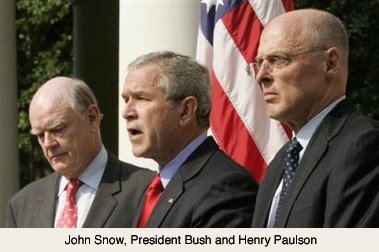
Only one Snow left in the White House

In a long-expected move, Treasury Secretary John Snow has resigned. Bush quickly nominated Goldman Sachs CEO Henry Paulson to replace him.

It's been something of a revolving door at that position; Paulson will be Bush's third Treasury Secretary. Both of the previous ones (Snow and Paul O'Neill) did decent jobs, but that wasn't quite enough:

The administration is said to have been dissatisfied with both previous Treasury secretaries, believing that they could have done more to get credit for the administration for economic growth.

News flash: presidents aren't generally responsible for economic performance, good or bad. Yes, they tend to be held responsible, and it's better to preside over a good economy than a bad one. But it's hard for a Treasury secretary to make a case for a causal connection that doesn't exist.

There were other problems with the job.

Snow informed the White House last week that he would resign after three years as the nation's chief economic officer. The secretary's decision was intended to bring finality to a process that has played out awkwardly in public over months as Snow's job security has been a regular source of Washington speculation....

But the White House spent months trying to find a prominent Wall Street figure to replace Snow, only to run into reluctance by many to take the cabinet job when economic policy was being set inside the White House.

That left Snow hanging out in the Washington rumor mill even amid reports that the White House wanted him out.

The Washington rumor mill can be pitiless, and who really wants to be a figurehead with no real power? Well, other than Tony Snow, that is....

One might well wonder why Paulson agreed to become that figurehead, especially for a lame-duck president with abysmal poll numbers who has made it clear that the job's main duty will be cheerleading the economy. He, like Snow, received assurances that he would "play a central role" in setting economic policy, but given his outsider status and the not-so-encouraging history of the Bush administration in that regard, I'm not holding my breath.

Which is too bad. Because Paulson isn't a bad choice, and some of his other biographical details -- chairman of the Nature Conservancy, for instance -- could lead one to envision him as a conduit for breaking the ideological orthodoxy that has guided the administration since 2000.

Call me cynical, but I expect him to be quickly isolated by other administration insiders, to never gain the policy-making influence he was promised and to grow frustrated with his cheerleader-in-chief role. We may not have seen the last Treasury nomination of this administration.

Side note
For those interested, Bush outright lied about the subject on Thursday:

That timeline raised questions about the president comments on Thursday night — four days after Mr. Paulson accepted the job — that he had not spoken to Secretary Snow about his long rumored departure from Treasury.

During a joint news conference with Prime Minister Tony Blair of Great Britain, Mr. Bush was asked directly by a reporter whether Mr. Snow had given him any indication that he intended to resign soon. Mr. Bush replied, "No, he has not talked to me about resignation. I think he's doing a fine job."

Tony Snow, said today that Mr. Bush was speaking "artfully," to avoid upsetting the markets with a nomination that he was not yet ready to announce, pending a background check.

"Artfully"? It was a lie. I don't want to make too much of this -- it's understandable that Bush was not ready to reveal his choice, and did not want to surprise the markets -- but a flat-out lie is never a good idea. The president should not lie to the press, because once he has done so, it makes everything else he says suspect. He can refuse to answer, dodge the question, be deliberately vague -- any of a dozen strategies for controlling the flow of information. But lying should not even be considered -- something you'd think Bush would have learned by the fifth year of his presidency.

As you might suspect, left-leaning sites are all over this.

, , , , ,

Friday, May 26, 2006

The national-local conundrum

Do the Republicans deserve to lose big in November? Oh, my, yes.

Does that mean we should all vote Democrat, regardless of who the respective candidates are in any given race? Well, no.

So what are we going to do?

The GOP is starting to pull out the desperation line: "if you don't vote for us the Dems will take over, and they'll destroy the country!" The hope is that no matter how badly the Republicans have messed things up, their conservative supporters will still consider them the lesser of two evils compared to Democrats.

Sure, guys, whatever. On the face of it, it's a silly argument: I don't think either party will "destroy the country" with regards to security or other bread-and-butter issues. So that's a straw man.

But let's say the GOP is right, and the Dems will try to turn us into the Socialist States of America. So what?

Even if they lose Congress the GOP would still control the White House, still have a sizable minority in both houses of Congress, and the judiciary would still lean right. Bush might finally have to exercise his veto pen, but the worst we risk is congressional paralysis.

So for me, the upcoming election is a referendum on the governing party. And they deserve to go down in flames. Big, hot, center-of-the-sun-type flames, the ashes burned and reburned until the electrons have been stripped from their atoms, leaving nothing but a subatomic mist in their wake.

Do I think the Dems will do better? Well, they’d have a hard time doing worse. And it would be a mistake to give the Reps a pass on their proven failures merely out of fear of what Dems might do.

That said, it can get complicated. I generally like my own representative, Jim Ramstad, and may well vote for him even though he’s GOP (the weak Democratic opposition makes that decision easier). So I’m both part of the problem (voting for a GOP candidate) and part of the solution (voting for a moderate).

My excuse is that if the GOP had more Ramstads, they wouldn’t be in the mess they’re in. But if everybody thinks that way, the Republicans might keep control of Congress. And they really, really need to lose there.

But I'll take my chances. Because until we find a good way to elect true independents, the next best strategy is to elect moderate members of the major parties and gradually bring those parties more strongly toward the middle and away from their fringes.

, , ,

A modern My Lai?

This report has been expected for a while, but it's still not pleasant to read about.

Marines from Camp Pendleton wantonly killed unarmed Iraqi civilians, including women and children, and then tried to cover up the slayings in the insurgent stronghold of Haditha, military investigations have found.

Officials who have seen the findings of the investigations said the filing of criminal charges, including some murder counts, was expected, which would make the Nov. 19 incident the most serious case of alleged U.S. war crimes in Iraq....

First, let's note that the military appears to be handling this appropriately. You can't always stop people from behaving badly, but you can punish them afterwards.

The details:

A roadside bomb explosion killed a fellow Marine, Lance Cpl. Miguel Terrazas. Looking for insurgents, the Marines entered several homes and began firing their weapons, according to the report.

In its initial statement to the media, the Marine Corps said the Iraqi civilians were killed either by an insurgent bomb or by crossfire between Marines and insurgents.

But after Time magazine obtained pictures showing dead women and children and quoted Iraqis who said the attack was unprovoked, the Marine Corps backtracked on its explanation and called for an investigation.

This is a good example of the media performing a vital role: uncovering an unpleasant truth that otherwise might have gone unnoticed. It's not pleasant to face our dark sides, but the fact that we do so makes our society stronger in the long run. Covering up wrongdoing does nothing but guarantee more wrongdoing. And the victims aren't fooled: If U.S. soldiers get away with massacres, the Iraqi people will know and it will undermine everything we claim to be doing in Iraq. If we punish the perpetrators, on the other hand, it builds trust.

The killings will evoke comparisons to Vietnam's My Lai massacre, and the parallels are there: Frustrated troops fighting an elusive enemy taking their frustration out on innocent villagers. But there are differences: the scale (hundreds died at My Lai), the level of command involvement (the troops at My Lai were practically invited to kill civilians) and the response (My Lai was covered up for a year before an investigation began, and then for another six months while charges were prepared).

So be wary about going too far down the road suggested by the headline on this post. Incidents like these should not be used to tar all service members. Most serve honorably, often in extremely trying circumstances. U.S. soldiers are among the most well-disciplined in the world. Unless there is evidence of widespread wrongdoing, this case should be treated as what it appears to be: an isolated tragedy that should be investigated fully and addressed swiftly and fairly. And as a cautionary tale of the dehumanizing effects of warfare, and why it should be considered an option of last resort in our foreign policy.

Update: The New York Times has a much better story on the subject.

, , , , ,

Time ordered to turn over Plame drafts

The judge in the Valerie Plame case has ordered Time magazine to turn over drafts of articles written by reporter Matthew Cooper.

The judge found "a slight alteration between the several drafts of the articles" Cooper wrote about his conversations with Libby and the reporter's first-person account of his testimony before a federal grand jury.

"This slight alteration between the drafts will permit the defendant to impeach Cooper, regardless of the substance of his trial testimony, because his trial testimony cannot be consistent with both versions," Walton wrote.

A person familiar with Cooper's drafts described the inconsistencies as "trivial." The person spoke on condition of anonymity because Walton has warned the case's participants against talking to reporters.


This seems like a minor development, but it's always tricky when newspapers are ordered to turn over unpublished material. Reporters are able to get stories because sources trust their discretion and judgement. Reporters often get information "on background", for instance -- meaning not for publication or attribution -- to help them make sense of the information they can publish. If such private information is too easily seizable by a court, it could cause sources to clam up, seriously hampering the work that reporters do.

If it comes down to it, a defendant's right to a fair trial outweighs a newspaper's right to keep its files confidential. But care should be taken that any demand for media files is narrow, and that the information sought is necessary, clearly relevant and unobtainable any other way.

The judge appears to have done that in this case -- unless the discrepancies truly are trivial. In that case the dubious benefit to Libby does not justify seizing the files.

, , , ,

Blog power

I got the following mass e-mail from Katie MacGuidwin of the Republican National Committee today.

You’ve heard the buzz – now, take advantage of a new tool on GOP.com that has many features built specifically for bloggers.

Through MyGOP, you can create your own website on GOP.com. The address could be as simple as yourblogname.GOP.com. Through your MyGOP site, you can:

- Keep track of personal fundraising efforts through a personal fundraising page

- Keep tabs on the number of people you recruit, and even run a voter registration drive

- Build a personal e-mail list to distribute your news and GOP talking points

- Post photos

- Link to your blog

- Sidebar widgets to post to your blog promoting your site and your campaigns

- Move up in the rankings through our live leaderboard post on www.GOP.com/MyGOP/.

This tool was built partly in response to feedback from bloggers who asked how they could keep track of the activity they generated through their blogs. Now, you have the opportunity to make an impact online for 2006 and 2008, and to be able to know how many dollars you raised, volunteers recruited, and voters you registered.

Recruiting? Fundraising? A live leaderboard? "Distribute GOP talking points"?

I thought bloggers were supposed to be independent observers. Are they really just supposed to be conduits for party propaganda? Should bloggers really be competing to see who can most slavishly follow the party line, raise the most money for the party, and so on?

It's a GOP effort, but I'm sure the Democrats have something similar going on.

This sort of thing highlights both the power of blogs and the challenges facing them as parties increasingly try to co-opt them. Will conduit blogs be readily identifiable? Or will the independent voices get lost in a sea of party drones?

It's enough to make a blogger say "there ought to be a law" or something.

, ,

Thursday, May 25, 2006

Abbas rolls the dice

Palestinian president Mahmoud Abbas has given Hamas a choice: accept the idea of co-existence with Israel within 10 days, or he'll call a referendum to settle the issue.

Abbas asked Hamas to endorse a document drawn up by senior Palestinian militants imprisoned in Israel. It accepts statehood in the West Bank, Gaza Strip and east Jerusalem — territories captured by Israel in the 1967 Middle East War.

Approving the document would imply recognition of Israel — one of the three conditions imposed by Israel and the West for doing business with the Hamas-led government. The document falls short of meeting the other two conditions — renouncing violence and accepting past peace accords — so it was unclear if the international boycott would be called off even if Hamas acquiesced.

However, a referendum, which Palestinian pollsters expect to pass, could provide cover for the militants to become more moderate without appearing to succumb to Western pressure. Such a vote could also renew pressure on Israel to return to the negotiating table rather than impose borders on the Palestinians.

It's a bold move, akin to cutting the Gordian Knot. And the fact that such a plan would likely be approved by voters demonstrates that Hamas does not represent the average Palestinian on this fundamental point.

Worth a try, anyway. Along with Israel's plan to draw unilateral borders, the move puts increasing pressure on Hamas to compromise or be marginalized.

, <, <, <,

Just shoot them all

Okay, that's an overreaction. But the continued revelations in the Plame case can really make you want to put all the participants in a bus and drive it off a cliff.

On September 29, 2003, three days after it became known that the CIA had asked the Justice Department to investigate who leaked the name of covert CIA officer Valerie Plame, columnist Robert Novak telephoned White House senior adviser Karl Rove to assure Rove that he would protect him from being harmed by the investigation, according to people with firsthand knowledge of the federal grand jury testimony of both men....

After the September 29 call, Novak shifted his account of his July 9, 2003, conversation with Rove to show that administration officials had a passive role in leaking Plame's identity.

On July 22, 2003 -- eight days after the publication of Novak's column on Plame -- Newsday reporters Timothy Phelps and Knut Royce quoted Novak as telling them in an interview that it was White House officials who encouraged him to write about Plame. "I didn't dig it out, it was given to me," Newsday quoted Novak as saying about Plame. "They thought it was significant. They gave me the name, and I used it."

...Novak did not speak publicly on the matter again until September 29 -- later on the same day as his conversation with Rove in which he assured the president's chief political aide that he would protect him in the forthcoming Justice Department investigation.

"I have been beleaguered by television networks around the world, but I am reserving my say for Crossfire," Novak said on his own CNN program, which is no longer on the air. "Nobody in the Bush administration called me to leak this. In July, I was interviewing a senior administration official on Ambassador [Joseph C.] Wilson's report [on his Niger trip], when [the official] told me the trip was inspired by his wife, a CIA employee working on weapons of mass destruction. Another senior official told me the same thing.

Novak is sleaze. Rove, Libby and Cheney all appear to have been actively involved in revealing Plame's identity. The question of whether that was a crime revolves around whether Plame was undercover or not -- and it now appears that she was -- and whether they knew it at the time, which will be very hard to prove even if they did. But at a minimum we have them carelessly bandying about an agent's name, and then scrambling to obscure the fact when it blew up in their face.

So put 'em all on the bus. Put Wilson on it, too, just for being irritating. Drive it up to the highest point on the Pacific Coast Highway, aim it at the ocean, tie a brick to the accelerator and release the brakes. The world will be a better place for having done so.

, , , , ,

Fast train to irrelevancy

The state legislative session has ended, and the big news (as far as I'm concerned) is that the Central Corridor extension of the light rail system is on the front burner, and drawing strong public support.

Those who testified were asked to comment on a recently completed draft environmental impact study, and to say which transit option they want. Should light rail or bus rapid transit be the mode of transportation along University Ave.? Or do citizens want the status quo and keep the avenue the way it is, with car and bus traffic?

Overwhelmingly, those who testified said they wanted something different, and that light rail is their preferred mode.

Even more pleasant, from my point of view, is how marginalized the Taxpayers League has become on this and other issues.

The League, apparently undeterred by the unqualified success of the Hiawatha line, opposes the Central Corridor extension.

(They also oppose the Northstar Commuter Rail. Their analysis is flawed to start with -- subjecting rail lines to cost-benefit analyses that they don't direct at roads -- and their "build more roads" solution fails the history test.)

Why do they oppose the Central Corridor? They cite the cost, a negligable impact on traffic congestion and opposition by many business owners along the proposed route.

But the cost will be amortized over many years and many, many riders. And the point of light rail is to provide transportation options and slow the growth of traffic congestion; the Met Council, for instance, has never claimed that it would greatly reduce congestion.

And most business owners are concerned about business disruption during construction of the line; they're not opposed to the existence of the line itself. The loss of 660 parking spaces is a minor concern, since the line would carry far more people than that each day. It should be a boon for business, not a liability.

That might be why the Minneapolis Regional Chamber of Commerce supports the line. Apparently the Taxpayers League doesn't speak for most business owners.

But then, they never did. They've always represented a small and secretive cadre of backers. Their political influence peaked during the last gubernatorial election (with their "no new taxes" pledge). But then politicians got burned by that pledge, and the public support for mass transit projects became apparent. More directly, their credibility collapsed as their "solutions" became increasingly nonserious. Remember the transit strike, and the League's suggestion that it would be cheaper to buy every poor person a used car?

If we want the Twin Cities to grow in a sensible fashion, it needs to grow with mass transit in mind. And that means having the mass transit systems in place. It would be far more expensive and disruptive to wait another 10 or 20 years and try to graft a mass transit system on to a metro area that grew without regard for such a system. Focusing on the short-term costs is shortsighted. We're building for the future, and doing it with narrow, high-capacity rail lines instead of four-lane highways. It's smart, it's forward-looking and it exposes the pennywise nature of the Taxpayer's League.

, , , , , ,

Wednesday, May 24, 2006

Newspaper apologizes for false Iran story

Canada's National Post has apologized for printing a story saying Iran was going to require Jews to wear yellow badges.

"It is now clear the story is not true," Douglas Kelly, the National Post's editor in chief, wrote in a long editorial on Page 2. "We apologize for the mistake and for the consternation it has caused not just National Post readers, but the broader public who read the story."

This was unusual in that it's a mainstream newspaper. But it comes at a time when a lot of false stories are getting circulated: the Karl Rove indictment, for instance, or the Internet movie featuring alleged Ranger Jesse Macbeth.

More than ever it pays to pay attention, and try to separate the trustworthy information sources from the trash.

, , , ,

Pelosi asks Jefferson to resign committee post

Nancy Pelosi has asked Rep. William Jefferson, D.-La., to resign from the powerful Ways and Means Committee.

Jefferson quickly refused.

, , , ,

Bush on pensions

You might not know it, but I'm not a big fan of President Bush. However, he occasionally does something right. And his proposals for pension reform are one of them.

The basic problem is this: pensions are underfunded by a staggering amount -- $450 billion or so. This puts workers' retirements at risk, but it also threatens the survival of weaker companies. And when those companies shed their pension liabilities in bankruptcy, taxpayers pick up the tab.

Why the underfunding? Some of it can be blamed on corporations promising more than they could afford, or chintzing on their contributions. But some of it results from the complexity of trying to estimate how much money you will have 30 years from now.

Such a calculation requires assumptions about what the economy as well as specific investments will do over that time span. No one really knows what will happen that far out, so all you can do is make educated guesses. Change your guess, and you change the result: a pension fund that is paid up under one set of assumptions could show up as deeply in the red under another set.

Then you have complications, like when companies make their contribution in stock instead of cash or other assets. Enron's pension fund, for instance, would have been fully funded right up until the day it collapsed.

We could simply require companies to make up the difference immediately. But there are trade-offs there, too. If United Airlines had been forced to retain its pension liabilities when it declared bankruptcy it would have been liquidated, throwing 57,000 employees out of work and sending additional shockwaves through the broader economy. Would that have been a preferable result?

So it's not a simple question of forcing companies to pay up. And the administration's proposals reflect that.

They have three basic ideas:

1. Strengthen minimum funding rules. This would replace the current hodgepodge of funding methods with a single set of acceptable procedures. It would require healthy companies to fund the full normal liability, while weaker companies would have to cover "at-risk" liability -- the amount that would have to be paid out if the plan terminated early and resulted in accelerated payment of benefits. They would also set minimum payments for plans that are underfunded, and not allow underfunded plans to increase benefits. In the worst cases, benefits would be frozen until the company made up the shortfall.

Improve disclosure. Requires that plan participants be notified of any underfunding.

Raise pension insurance premiums. This is a direct effort to fix the financing of the Pension Benefit Guaranty Corp., which is $23 billion in the red after absorbing the pension liabilities of several large corporations.

The cumulative effect should be more reasonable funding of pension benefits and less exposure for taxpayers.

The one glaring hole in this proposal is that government pension plans remain exempt from the rules. There's a reason for that: it lets the government buy off its workers with ever-increasing pension benefits without having to account for the true cost of those benefits. Taxpayers 30 years from now will find themselves on the hook for huge pension costs that were never properly discussed or provided for. That's inexcusable; the government should have to abide by the same rules it imposes on the private industry.

In the end, though, this whole discussion -- and the spate of pension fund failures -- should probably convince workers that pension promises are largely worthless, a form of deferred payment that is not guaranteed. Lucrative as they can be for workers who qualify for maximum benefits -- working their entire careers at companies that last long enough to pay up -- they're much less valuable to today's workers, who move around from job to job and work for companies that likely won't survive 30 years.

With defined-contribution pensions, workers get the money now, and they can take it with them when they change jobs. Though we need protection for older workers as we transition to a system without defined-benefit plans, the new global economy makes clear that trusting your retirement to your company has become a foolish gesture indeed.

, , ,

Tuesday, May 23, 2006

CIA officials to testify against Libby

Looks like Fitzgerald might have a case after all:

Two top CIA officials will bolster prosecutors' charge that Vice President Cheney's chief aide lied to them, court papers show.

Prosecutors say disgraced Cheney chief of staff Lewis (Scooter) Libby learned CIA spy Valerie Plame's identity from, among others, agency officials who will be called to testify at his trial for perjury, false statements and obstruction of justice....

Libby has said journalists told him about Plame - not Cheney or the six witnesses named so far by prosecutors.

Other than prematurely describing Libby as "disgraced", the article seems solidly sourced. The CIA men told Libby about Plame in response to direct inquiries from him -- so it'll be hard to use the "I can't remember" defense.

Apparently he's not going to be joined any time soon by Karl Rove, as the Truthout report to that effect remains unconfirmed by anyone else.

, , , , ,

Monday, May 22, 2006

Stripping civil liberties one packet sniffer at a time

Speaking of Donklephant, they've got a nice analysis of Wired magazine's release of documents from the privacy lawsuit against AT&T. The Electronic Frontier Foundation filed the suit in response to the NSA phone database revelations.

What makes this whole thing especially alarming though, is that by tapping into AT&T, the NSA actually has access to much more than just AT&T customers’s data. Qwest was apparently the only major US telecom company that refused to work with the NSA on this program. So let’s say you’re a Qwest customer. You instant message a friend of yours who, unfortunately, is an AT&T customer. Because of the nature of IP routing, your traffic may very well have been routed through the NSA’s no longer very secret room even though you have no relationship with AT&T at all. According to Wired, ConXion, Verio, XO, Genuity, Qwest, PAIX, Allegiance, AboveNet, Global Crossing, C&W, UUNET, Level 3, Sprint, Telia, PSINet and Mae West were all compromised as a result of the fiber optic splitters that were installed at AT&T. The claim that this is targetted surveillance is growing much harder to believe,


More at the links. Check 'em out.

, , , , ,

Incompetence in Iraq

If you want to get mad, read this.

As chaos swept Iraq after the American invasion in 2003, the Pentagon began its effort to rebuild the Iraqi police with a mere dozen advisers. Overmatched from the start, one was sent to train a 4,000-officer unit to guard power plants and other utilities. A second to advise 500 commanders in Baghdad. Another to organize a border patrol for the entire country. ...

Before the war, the Bush administration dismissed as unnecessary a plan backed by the Justice Department to rebuild the police force by deploying thousands of American civilian trainers. Current and former administration officials said they were relying on a Central Intelligence Agency assessment that said the Iraqi police were well trained. The C.I.A. said its assessment conveyed nothing of the sort.

After Baghdad fell, when a majority of Iraqi police officers abandoned their posts, a second proposal by a Justice Department team calling for 6,600 police trainers was reduced to 1,500, and then never carried out. During the first eight months of the occupation — as crime soared and the insurgency took hold — the United States deployed 50 police advisers in Iraq.

Against the objections of Colin L. Powell, then the secretary of state, the long-range plan was eventually reduced to 500 trainers. One result was a police captain from North Carolina having 40 Americans to train 20,000 Iraqi police across four provinces in southern Iraq.

You mean the Bush administration based policy on a complete fantasy, and executed the plan with extreme incompetence? Man, that's hard to believe....

I've said several times that, no matter what you think of the rightness of going into Iraq, we should all be incensed by the sheer incompetence of the execution. From sending in too few troops (and now too few policemen) to secure the country, to disbanding the Iraqi army, to lowballing cost estimates, to the near-complete lack of planning for the occupation, to the ignoring of the ethnic and religious divisions that had been papered over by Saddam, this administration has screwed up just about everything it undertook in relation to Iraq. The result is that even if we do "win" in Iraq -- however you define that -- the cost will be far, far higher than it needed to be.

Head on over to Donklephant for more discussion of the story.

, , , , ,

Montenegro votes for independence

The dissolution of Yugoslavia is now complete.

Montenegro's referendum commission has confirmed that slightly more than the required 55 percent of voters supported independence for the tiny republic in Sunday's referendum.

In the capital Podgorica, a key-stronghold for the pro-independence-camp, young people in particular welcomed the birth of Europe's newest nation, with some shooting Kalashnikov rifles in the air, waving flags, and dancing.

At 600,000 people, it becomes one of the smallest nations on earth. And with this final breakup, we've gone a long way toward recreating the Balkans of the early 20th century -- a period of political instability that gave us the term "Balkanization" and helped spark World War I.

Let's hope things go better this time around.

, , , ,

Gonzalez considers charging reporters in NSA leaks

Striking another blow for government secrecy, Attorney General Alberto Gonzales may prosecute reporters for having the audacity to listen to sources describe a secret, controversial and possibly illegal warrantless surveillance program.

On the talk show, when asked if journalists could be prosecuted for publishing classified information, Gonzales responded, "There are some statutes on the book which, if you read the language carefully, would seem to indicate that that is a possibility."

He was referring to the 1917 Espionage Act, which made it a crime for an unauthorized person to receive national defense information and transmit it to others.

This is Gonzales at his best, carefully parsing the letter of laws for anything that can be used to support a preferred course of action, without regard to context, morality or intent. It's the kind of lawyering that let him find torture exceptions to the Geneva Convention. It should surprise no one that Gonzales would resort to such technocratic lawyering, but it should persuade no one, too.

Conservatives have become quite enamored of the 1917 Espionage Act, being as it's the only extant law on the books that affords even the possibility of jailing reporters -- something of a conservative wet dream, it seems.

The problem is that the Espionage Act was a horrid piece of legislation, much of which has been explicitly and implicitly repudiated by successive Supreme Courts in the 90 years since its passage.

The law provides that any attempt to communicate or publish information related to national defense is a criminal act, if doing so was intended to harm national security. The harshest penalties apply if such actions occur during wartime.

The law is incredibly broad and vague, and could apply to just about any reporting on any aspect of military operations that doesn't involve merely repeating official military communications. Used aggressively, the law would gut any meaningful independent coverage of wartime conduct.

It also points up once again why treating our battle against terrorism as a "war" in the conventional sense is a really, really bad idea. Doing so will extend "extraordinary" wartime suspensions of civil liberties into ordinary everyday realities. And democracy is the loser when the public can no longer maintain credible independent oversight of government actions.

It speaks volumes about the administration that it is willing to reach back into the mists of time to find a bad law that it can use to silence its critics and stifle public discussion about the conduct of this "war". I hope they get their butts handed to them for even considering it.

, , ,

Congressman videotaped accepting bribes

Yesterday, details of the bribery case against Rep. William Jefferson were leaked to the media.

Rep. William J. Jefferson (D-La.), the target of a 14-month public corruption probe, was videotaped accepting $100,000 in $100 bills from a Northern Virginia investor who was wearing an FBI wire, according to a search warrant affidavit released yesterday.

A few days later, on Aug. 3, 2005, FBI agents raided Jefferson's home in Northeast Washington and found $90,000 of the cash in the freezer, in $10,000 increments wrapped in aluminum foil and stuffed inside frozen-food containers, the document said.

Whoops. That sure doesn't look good. They've got confessions, videotape, audio recordings and cash stashed in the freezer.

Jefferson's lawyer is understandably outraged about the leak of 9-month-old records -- there is clearly a political motive there. But it's hard to claim the info is not newsworthy, and it's pretty damning. Jefferson deserves his trial, of course. But if the FBI has this much evidence, it's an open and shut case.

, , , , ,